In April I wrote an open letter about Virgin Galactic and hoped the company would turn around. Seven months later I have read its filings, its contracts, a court record and a book about the people who built its spaceships. The engineering was real. The structure around it is built so that some are paid whether the ship flies or not.
Why I am writing again
On 1 April 2026 I published an open letter to Sir Richard Branson1. I wrote it as an engineer who wanted the project to survive. My point was simple: the financial clock and an experimental vehicle were on a collision course, and the leadership was built for a mature operator, not for a test programme. I asked for a slower flight rate, for open engineering data and for a serious look at who runs the company.
I stand by that letter. But I read the company as an engineering problem with a money problem attached. I did not read the contracts, and I did not read the court files. This article is about what they say.
One fact I should have had in April, because it was already public: on 30 March 2026, two days before my letter, the company's annual report stated "substantial doubt" about its ability to continue as a going concern2. Every quarterly report since has repeated it. The latest one, filed on 12 November, lists the plans to solve the problem — start commercial flights, collect the customers' final payments, sell more shares — and then states that these plans "cannot be deemed to be probable"3. That is the company's wording, not mine.
I also got one fact wrong. The engineers are not "inside Mojave", as I wrote. The new ships are assembled in Mesa, Arizona, and fly from Spaceport America in New Mexico2. Whoever asks a company for accurate data owes accurate data in return.
Let me say where my heart is before I go on. I do not want this project to die. I have spent a career inside complex machines, and what these engineers and test pilots built is not a joke. So this is not a hit piece. It is an attempt to show, from documents anyone can read, why a good spaceship can end up inside a structure where it may never get the chance to prove itself.
The ship, and the people who built it
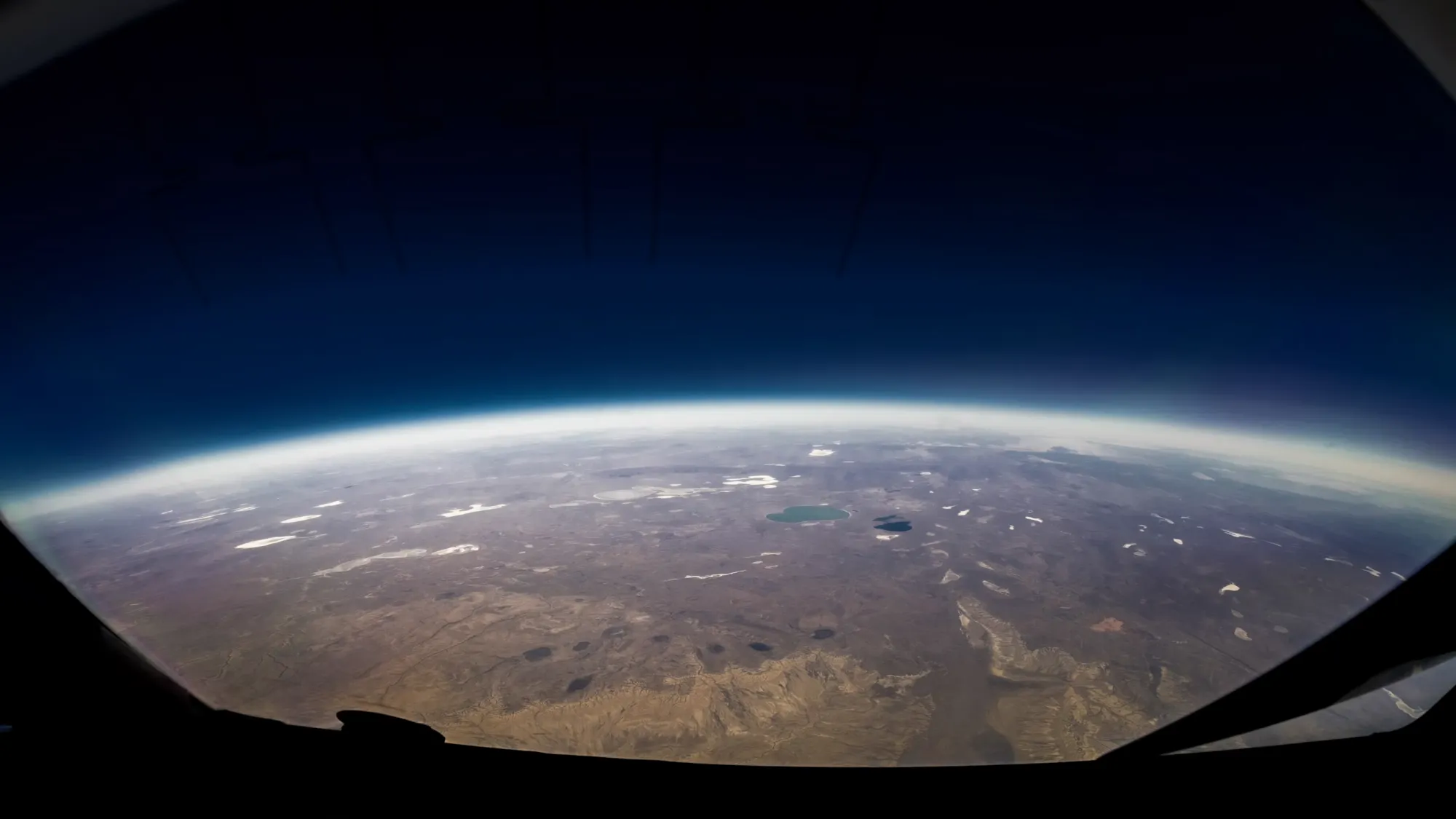
Virgin Galactic's spaceship rests on one brilliant idea. Burt Rutan, the designer whose company Scaled Composites built SpaceShipOne with Paul Allen's money, wanted a way to bring a winged rocket plane back from space without a heavy heat shield and without a pilot fighting the airflow. His answer was the "feather": the tail booms fold upward, the ship falls belly first like a shuttlecock, and the air itself holds it stable. He first tested the idea by throwing foam models off a control tower20. In October 2004 SpaceShipOne flew to space with it and won the X Prize20.
The feather is also what killed a man. On 31 October 2014 the first SpaceShipTwo, VSS Enterprise, broke up over the Mojave Desert during a rocket-powered test flight. The copilot, Mike Alsbury, unlocked the feather too early, while the ship was still in the transonic region; the air forces did the rest. He died; the pilot, Peter Siebold, survived20. The accident investigators found the root cause not in the copilot but in the design process: the builder had not protected the vehicle against the possibility that a single human error could cause a catastrophe21.
What came next deserves respect. Virgin's own engineers took over and built the next ship, VSS Unity. The accident report lists the measures taken afterwards to prevent an early unlock of the feather21, and the book about the test pilots describes Virgin's engineers pressing for bigger stabilizers, more latches and more inhibitors20. Unity was flying its glide-flight programme by early 2017, made its first rocket-powered flight in April 2018, and reached space in December 2018, carrying research payloads for NASA on what the company counts as its first revenue flight20,38.
In my view, what this team built up to 2016 is probably the most advanced feathering system that exists — a mechanism that turns a fall from space into a stable, nearly hands-off descent. The engineering was right. What I doubt is the organisation that came to sit on top of it: one built for customer experience and brand, not for flight test. The chief executive ran the Disneyland Resort and then Disney's international parks before he joined; the executive in charge of astronaut operations led human resources in Disney's parks and experiences business11. Those are strong backgrounds for customer experience and for people. Neither is a flight-test background. In April I wrote that the company's leadership was optimised for the company it hoped to become, not the one it still is1. After reading the record, I think that was too polite.
Because the record also shows the strain on the people below. In February 2019, as the book tells it and as the court summarised the complaint in 2022, Unity returned from space with damaged horizontal stabilizers: during earlier maintenance, technicians had re-covered them with a protective film and in doing so sealed the small vent holes that let air pressure escape at altitude20,14. One of the senior test pilots came to distrust the maintenance work, and with it the people leading the company20. While the ship was grounded, the company moved its operations to New Mexico. And in October 2019, with Unity still unable to fly, the company went public on the New York Stock Exchange, with Branson in a space suit ringing the bell20,14.
The most experienced test pilot of the programme, Mark Stucky — the pilot who first took SpaceShipTwo to space, in December 2018 — is the central figure of that book20,38. According to the shareholders' class-action complaint, the company fired him in a video call in July 2021, after he had raised safety concerns with the journalist who wrote it15. That is an allegation in a court filing, not a finding. But it tells you whose voice was missing when the next decisions were made.
So when I criticise this company, I do not criticise the people who bent carbon fibre in Mojave and Mesa, or the pilots who strapped in. I criticise what was built around them.
The company in numbers, November 2026
The ship. The first of the new Delta-class spaceships, Apeiron, has flown once: on 28 October 2026, attached under its carrier aircraft, as a ferry flight from the factory to the spaceport5,44. It has not flown free. The company now expects the first glide flight in January 2027 and the first paying passengers early in the second quarter of 20274.
The schedule. In May the first commercial flight was planned for the fourth quarter of 20266. In August it became February 20277. On 12 November it became early in the second quarter of 20274. Three dates in six months. The old ship, Unity, flew its last commercial flight in June 2024; there has been no commercial flight since2,3.
The money. In 2025 the company had revenue of $1.5 million and a net loss of $279 million2. In the first nine months of 2026 the revenue was $0.8 million and the net loss $179 million. Running the company and building ships and facilities cost $283 million in cash in those nine months4. That is a little over one million dollars a day.
The cash. At the end of December 2025 the company held $338 million. At the end of September 2026 it held $184 million, and $31 million of that are customer deposits it may not yet use4. In between it sold 45 million new shares for $145 million3. In the third quarter it sold none, and the cash fell by $102 million in three months. Against that cash stood $192 million of debt. Most of it, $172 million, is notes due in 2028 at 9.8 percent interest, secured on substantially all of the company's assets3.
The shares. In December 2025 there were 73 million shares. On 5 November 2026 there were 152 million3. 45 million were sold on the market at an average of about $3.22. Another 28 million went to lenders: $93 million of debt was paid with shares and share warrants instead of cash3,8. Anyone who held Virgin Galactic in December now owns less than half of the part of the company they owned then.
What comes next. On the day of the quarterly report the company opened a new programme to sell up to $250 million of shares9,10. At $2.87, the closing price the day before the report, that is about 87 million more shares, on top of 152 million. At a lower price it would be more. The contract with its lenders requires that at least 35 percent of the net proceeds go to repaying their notes9. The company also intends to swap its last $18 million of notes due in 2027 for shares9. And if the fourth quarter goes as the company forecasts, about $70 million of freely available cash will be left at the end of the year, before any new share sales — my arithmetic from its figures4 — less than one quarter of spending. The first paying flight is planned for the spring.
Where the money goes
A million dollars a day is a number without a shape. So I tried to find out what it is spent on, and who receives it. The filings answer the first question. They do not answer the second.
For the first nine months of 2026 the company reports four blocks3,4. $86 million for "spaceline operations": running the system, and the part of building the ships that may not be booked as an asset. $79 million for selling, general and administrative costs: the pay of management, finance, legal, IT, marketing and personnel, plus fees and offices. $14 million for research and development. And $121 million of capital expenditure, which the company describes in one sentence as mainly the new spaceships.
As an engineer I expected research and development to be the largest block. Two years ago it was: $153 million in 2024. It fell to $80 million in 2025 and to $14 million in nine months of 20262,3. The engineering did not stop. The label changed: the company declared the development phase complete, and the building of the ships is now booked partly as operations and partly as an asset. Taken together, the ships take about three quarters of the spending. Administration takes the remaining quarter.
Two numbers stand out. The first is that quarter: $79 million of administration in nine months, in a company with $0.8 million of revenue and 694 employees at the end of 20252. Nearly three quarters of all share-based pay is booked there3. The second is on the balance sheet: $409 million of "construction in progress", up from $118 million two years earlier2,3. It is a single line. The filings do not say how much of it is the first ship, the second ship, the tooling or the factory. An unfinished asset is not depreciated. If its cost can no longer be recovered — for example because the ships never enter service — the accounting rules require it to be written down. A text search of the latest quarterly report, filed on 12 November, finds no mention of impairment3 — in the same report that states doubt about the company's survival. That does not show the accounts are wrong. It shows that the reader cannot see whether the question was asked.
And who is paid? Two outside companies build the major parts. Bell Textron, part of the US group Textron, builds the feather system and the flight-control surfaces; Qarbon Aerospace builds the fuselage and the wings. Virgin Galactic keeps the design authority and does the final assembly. The contracts were announced in November 2022; their value was never disclosed23. The only payments to the Virgin Group that the filings disclose are the brand royalty and a director's fee: in 2025, one of the two directors whom Virgin names received no shares, and his cash retainer of $125,000 a year was paid not to him but to his employer, the Virgin Group11. The company's sites are leased from public bodies and unrelated landlords2.
Beyond that the filings show no amounts per supplier, no payroll by function and no cost per ship. To be fair: the rules do not require that detail, and most listed companies show no more. But most listed companies do not ask their shareholders for a million dollars a day.
Who earns, who carries the risk
The name. Virgin Galactic does not own its name. It licenses it from Virgin Enterprises, a company of the Virgin Group, under a contract that runs until October 20442. The fee is a small percentage of sales or a fixed quarterly minimum, whichever is higher. The minimum steps up from the first flight with paying astronauts, rises over four years and then follows inflation2,3. In 2025 Virgin Galactic booked $2.5 million of royalty expense; its revenue was $1.5 million. In the first nine months of 2026 the royalty was again $2.5 million; the revenue was $0.8 million2,3. Next to a loss of $179 million, $2.5 million is small. What counts is that it does not follow sales, it rises, and it runs until 2044.
The licence has exits, too — for the licensor. Virgin Enterprises may end it if the company becomes insolvent, if it is sold to a buyer the licence calls unsuitable, such as a competitor of Virgin2,11, or if flights with paying passengers stop for longer than a set period — unless the pause is needed to address a significant safety issue2.
The control. According to the court record, Branson, through companies he controlled, sold Virgin Galactic shares worth about $1 billion between the stock-market listing in 2019 and October 202114. His group's present stake is not published. The proxy statement of April 2026 lists no shareholder above 5 percent11. But under an agreement from 2019 the Virgin Group keeps the right to name two directors as long as it holds 1,434,880 shares — counting shares it passed to a third party in 2020, until that party sells them — and one director down to 573,952 shares11. In April 2026 it still had the right to name two11. Only Virgin may remove the directors it names10. And with the seats comes a list of decisions the company may not take without Virgin's written consent: selling new shares, larger new debt, a merger, a sale of the business, a liquidation, changes to the charter10.
Put a price on that. At $2.87 a share, the price of 11 November, 1,434,880 shares cost about $4.1 million; 573,952 shares cost about $1.6 million. That is 0.95 and 0.38 percent of the company. Read it the way an engineer reads a load path: a shareholder whose stake may be below one percent holds the brand, two board seats and the key to every exit. The other shareholders carry the dilution.
The management. For 2025 the board awarded the chief executive $10.7 million. That is seven times the company's revenue and almost twice his pay for 2024. Compare it with Nvidia: for the fiscal year that ended in January 2026, Nvidia's board awarded its chief executive, Jensen Huang, $36.3 million, on revenue of $215.9 billion43. Virgin Galactic's board awarded its chief executive almost a third of that, on revenue of $1.5 million. His annual bonus was calculated from a company score of 75 percent of target, to which the board applied a personal multiplier of 130 percent, which brought it to 98 percent of his target; the other executives received multipliers between 101 and 107 percent11. The four named executives together were awarded $18.5 million. These are the company's own figures. I have never met the chief executive and I do not judge the man. I judge the decision, because it is public.
The owners. The shareholders voted on that pay in June 2026. 7.4 million shares voted yes and 3.6 million voted no12. That was a majority of the votes cast — and 7.8 percent of all shares. 33 million shares held through brokers were not voted on the question at all, and about half of all shares were not represented at the meeting11,12.
The customers. More than 700 people hold reservations, worth about $237 million to the company when they fly3. The company holds $80 million of their deposits; $31 million of that is set aside by contract until the conditions of the flight are signed3,4. The rest is part of the company's ordinary cash. That is lawful, and it is disclosed. It also means that the customers carry a part of the risk.
The staff. At the end of 2025 the company had 694 employees, 50 fewer than a year before2,13.
So here is the structure, without adjectives. The licensor receives a rising minimum, flights or no flights. The lenders hold a first claim on substantially all of the company's assets, and they are repaid first out of every new share sale. The management's bonuses were raised above the company score by personal multipliers. The shareholders pay through dilution, and the customers wait. None of this is hidden. All of it is in the filings.
July 2021: the flight, the warnings and the sale
There is one episode where the structure and the ship meet in a single month. It is on the record of a United States federal court, and it is the reason I changed my mind about how much of this is bad luck.
On 11 July 2021 Branson flew to space on Unity — nine days before Jeff Bezos's first flight with Blue Origin14. During the climb, a warning appeared in the cockpit that the ship was leaving its entry glide cone — the corridor from which it can still glide back to the runway — and then a red warning that it had left it. The ship flew outside its cleared airspace for 1 minute and 41 seconds14,15,19. The flight was presented to the world as a complete success14.
In the five days after the flight, the company sold about 13.7 million new shares for $500 million14. According to the plaintiffs, citing the sworn testimony of the company's president, the red warning was discussed the same day in a debrief attended by the Federal Aviation Administration; the president told the chief executive about it on the day of the flight or the day after15. The complaint goes on, step by step: on 21 July the FAA asked the company for a report on the glide-cone warnings; on 23 July it told the company that it was investigating, and the president — again by his testimony as the complaint cites it — told the chief executive the same day; on 28 July the company was told to expect a letter from the FAA; on 3 August the company briefed the FAA, and the pilot in command admitted that the ship had left its airspace and that the FAA had not been told15. The defendants deny these allegations. In 2022 the same judge had dismissed the claims against the chief executive, because the complaint then did not allege that he knew of the deviation when he praised the flight14; the later complaint added the president's testimony.
On 10, 11 and 12 August 2021 companies controlled by Branson sold 10.4 million shares for $299.9 million14. On 11 August, according to the complaint, the FAA emailed the company's management that the flight was a "mishap" and that no further licensed launch could take place before corrective actions15. On 1 September The New Yorker reported the red warning light. On 2 September the FAA grounded the ship, and the share price fell from about $28 to about $25 within minutes14,15. On 29 September the FAA closed its investigation: the ship had left its assigned airspace, and the company had "failed to communicate the deviation to the FAA as required"18.
A federal judge looked at the sales in November 2022, before the president's testimony was taken. She found that his sales of 2020 and April 2021 did not support an inference of intent: the 2020 sales came months before any news that pushed the price down, and in April 2021 neither the next test flight nor his own flight had been announced. For the August sale she found the opposite: it came "just weeks before it was publicly revealed" that the flight had strayed, and she let the insider-trading claim against Branson go forward for exactly those three days of trades14. The case was later settled for $8.5 million; the defendants deny any wrongdoing; on 12 November the court's final approval was still pending3,16. Separate suits brought on the company's behalf against its directors were settled in August 2026, also with no finding of wrongdoing17. A ruling at that stage takes the plaintiffs' account as true and proves nothing. What Branson himself was told about the FAA's steps, the papers I have do not say. He was on board. According to the complaint, citing the president's testimony, the people in the cabin could see the warnings and heard the co-pilot read them out15. That, too, is an allegation, and it is denied.
Here is my line. Selling shares is legitimate. A founder may need money, and anyone may sell. What I call misleading is the order in which the public learned things: in July, a flight presented as a complete success; in August, the founder's sale; in September, the news that the ship had left its cleared airspace and that the regulator had not been told. Whether he knew of the deviation when he sold is what the plaintiffs allege and the defendants deny; no court has decided it. My point does not need that answer. A company that sells shares to the public should never let its public story run behind its own cockpit.
Not the first time
I wanted to know whether this is one company's bad luck or something that has happened before. So I went through thirteen Virgin businesses that worked with outside money. I took the failures and the successes, because a list of failures alone proves nothing.
| Business | Outside money | What happened | Outside shareholders | Virgin at the end |
|---|---|---|---|---|
| Virgin Galactic | New York listing, 2019 | Going-concern doubt since March 2026; no commercial flight since June 2024 | Share count doubled in 2026 | Sold shares for about $1 billion in 2019–21; licence to 2044; two board seats; consent rights |
| Virgin Australia | Australian listing, 2003 | Insolvency administration in April 2020; sold to Bain Capital | Lost everything | Lost its stake of about 10 percent; signed a new brand licence with the buyer; took 5 percent of the new company28 |
| Virgin Orbit | Nasdaq listing, 2021 | Chapter 11 in April 2023; sold in parts27 | Received nothing26 | Lost its own stake |
| Virgin Mobile USA | New York listing, 2007, at $15* | Sold to Sprint in 2009 | About $5.50 a share: minus 63 percent* | A slightly lower share price than the public, plus repayment of its loans, a tax-related payment and a licence fee29 |
| Virgin America | Nasdaq listing, 2014, at $23 | Bought by Alaska Airlines in 2016 at $57; name retired in 2019 | Plus 148 percent | Sold its shares in the takeover; the minimum royalty continues, confirmed in court in 202424 |
| Virgin Money UK | London listing, 2014; taken over in 2018 by the bank CYBG, which took the Virgin Money name* | Bought by Nationwide in 2024; name to be retired | 38 percent above the last market price25 | Sold its 14.5 percent in the takeover; exit fee of £250 million plus £15 million a year for four years25 |
| Virgin Mobile UK / Virgin Media | London listing, 2004 | Merged into the cable company NTL in 2006, which took the Virgin name; operating today | Gained* | The long brand licence continues |
| Virgin Atlantic | Private; Delta holds 49 percent | Solvent rescue in 2020 | No public shareholders | Put in £200 million of new money41 |
| Virgin Active | Private | Court-approved restructuring in 2021; landlords took losses42 | No public shareholders | Took part in the owners' new money42 |
| Virgin Voyages | Private | Operating | No public shareholders | Took part in the funding rounds of 2022 and 2023* |
| Virgin Megastores | Private; UK chain sold to its managers in 2007* | The UK chain, renamed, went into administration in 2008* | The buyers lost | Had sold; no stake left |
| Virgin Hyperloop | Private; Virgin was a minority investor and gave the name, 2017–2022* | Closed at the end of 2023* | The investors lost | Had withdrawn the name a year earlier* |
| Virgin Trains (UK) | Rail franchises with a partner | East Coast contract ended early in 2018; West Coast lost in 2019* | — | Shared the East Coast losses* |
Compiled from filings, court and takeover documents and contemporaneous press reports. Cells marked * rest on press reports only.
To be fair, and it matters: this record does not show a group that lets its companies crash. Where Virgin was an owner — Virgin Atlantic, Virgin Active, Virgin Voyages — it put new money in when things went wrong. Two listings made outside investors good money: Virgin America and Virgin Media. At Virgin Orbit, Virgin lost its own shareholding, and when shareholders later asked the bankruptcy court to reopen the case, the court refused26. I expected to find a pattern of hype, cash-out and crash. I did not find it.
What repeats — on the record
What does repeat is narrower, and it is in writing. In the listings I checked, the brand contract is built to outlive the shareholders' money.
The clearest case is Virgin America, because a court has written it down. Before the airline's stock-market listing in November 2014, Virgin could block a sale of the airline. The listing removed those veto rights and halved Virgin's seats on the board. In the same step the brand licence was rewritten: 25 years from the day of the listing, with a minimum royalty of about $8 million a year, rising with inflation. Two years later Alaska Airlines agreed to buy Virgin America. By 2019 the Virgin name was gone from the aircraft, and Alaska argued that no minimum was due for a brand it no longer used. In June 2024 the Court of Appeal in London decided otherwise: the minimum is a fixed sum, payable whether the name is used or not24.
Nobody lost money in that case. Virgin America's shareholders were bought out at $57 a share, two and a half times the listing price. But the court's account shows the design principle: at the moment Virgin gives up control, the contract is changed so that its income no longer depends on control.
Virgin Money shows the same principle at an exit. When Nationwide agreed to buy the bank in March 2024 and announced that the name would be retired, the takeover document also named the price of that: an exit fee of £250 million to Virgin Enterprises, plus fixed royalties of £15 million a year for four years25.
Now put Virgin Galactic next to these two. A licence to October 2044 — 25 years after the listing in October 2019, the same length Virgin America's licence got at its listing2,24. A minimum royalty that is already higher than the revenue. A right of the licensor to withdraw the name if the company becomes insolvent. And consent rights over share sales, debt, mergers and liquidation, held by a shareholder whose group sold about a billion dollars of shares in 2019–2114. It is the same construction. Only this time the product has not yet worked, and the shareholders are still inside.
And where a publicly held Virgin company did fail, the public shareholders were last in line, as shareholders always are — while Virgin was more than a shareholder. At Virgin Orbit in 2023 the shareholders received nothing26,27. At Virgin Australia in 2020 the shareholders lost everything; Virgin lost its stake as well — and then signed a new brand licence with the buyer and took five percent of the new company28.
Economists have names for the parts of this. Control held with a small share of the capital is a known structure, studied for decades32. Moving value legally from a company to those who control it has a name, too: tunnelling31. Countries differ in how strictly they make companies disclose and approve deals with their controlling parties; some require the approval of the shareholders who are not involved34,35. And there is a whole literature on executive pay that rises when performance does not, held in check mainly by the fear of public outrage33. None of these works is about Virgin Galactic, and I apply none of them to any person's intentions.
One more paper, because its title is blunt and its argument is not. In 1993 George Akerlof and Paul Romer described what happens when the people who control a firm can take out more today than their share in its future is worth: the aim of making the firm more valuable gives way to the aim of taking out what can be taken now30. Their cases were American savings banks of the 1980s, whose debts the state guaranteed. That is not the situation here, and I do not know anyone's intentions; nothing in the filings suggests that anything is concealed. I name the paper for one reason: it explains why an outsider should first ask who is paid regardless of the outcome, and only then ask whether the product works.
What this means for the ship
I am an engineer, so this is the part I care about most. A financial structure is not dangerous in itself. It becomes an engineering question at one point: when the same organisation has to decide "one more test flight" and "the money is running out" in the same quarter.
Look at how the best rocket plane in history was tested. The X-15 made its first captive flight under its carrier on 10 March 1959. It glided free for the first time that June, and first lit its rocket in flight on 17 September 1959 — three months from first glide to first rocket flight, with a single test pilot on board22. It first flew above 50 miles on 17 July 1962, three years after its first glide22. In 199 flights it lost one aircraft and one pilot, Mike Adams, in November 196722.
Unity, Delta's predecessor, was flying its glide-flight programme by early 2017, made its first rocket flight in April 2018 and reached space in December 201820,38. Its first commercial flight followed in June 20232 — more than six years after its glide flights began.
Apeiron made its first captive carry on 28 October 20265,44. The company expects the first glide flight in January 2027 and the first paying passengers early in the second quarter4. Glide flights, rocket flights, the first flights to full altitude, the operating licence and then passengers: all of it would have to fit into about three months. The latest results release and quarterly report give no number of test flights. Neither does the company's release of 28 October. It says only that customers will fly "upon successful completion of the flight test program"44. The results release and the quarterly report do not mention the Federal Aviation Administration at all3,4.
To be fair, Delta inherits Unity's design, its flight data and its crews, and much of Unity's years went into things other than test flying. A second ship of a flown design needs far less testing than the first. But I will say it plainly, as an engineer: a test campaign worthy of the name — from first glide to passengers on board — in three months is impossible. In my own work, redesigning a chiller pipe takes two months. The X-15 made a single glide flight; then an engine-bay fire, leaks and failing valves cost it three months before its first rocket flight22, and nobody was sitting in the back. Unity flew glide flights for thirteen months before its first rocket flight20,14.
Now look at the two clocks. If the company's forecast holds, and before new share sales, the freely available cash runs low in the first quarter of 2027. The test campaign is planned for the first quarter of 2027. And the phase ahead — rocket-powered flight through the transonic region — is the phase in which the first SpaceShipTwo broke up in 2014, in a design that had not been protected against a single human error21.
When the data say "fly again", every extra flight costs weeks, and every week costs about seven million dollars. Every engineer knows what a deadline does to judgement: the nearer the date, the less evidence it takes to say "good enough". Others have learned it the hard way: a RAND study for the US Air Force describes an unmanned test programme of the 1990s whose management pursued an aggressive schedule, and whose first aircraft crashed — after which that type did not fly again for 26 months40. I do not claim that anyone at Virgin Galactic will cut a corner. I say that this structure puts the people who must decide under the strongest pressure at exactly the moment when the vehicle needs the most patience. In July 2021, under a lesser pressure, the company did not report to its regulator, as required, that the ship had left its cleared airspace18.
The builders of stone arches knew the problem. The wooden frame under an arch costs money every day it stands, and the arch looks finished long before the mortar has set. Take the frame out a week early and you save a week — or you lose the arch.
Flight-test textbooks call the right method the build-up approach: test in steps, from the lowest risk to the highest, and let each step earn the next39. So I will do something simple, and anyone can do it with me: count. How many glide flights does Apeiron make before the first paying passenger? How many rocket flights? How many to full altitude? Is a milestone that was announced later merged with another one, or dropped? The X-15 and Unity are the yardstick. The numbers will be public, flight by flight.
And I repeat my request from April: open the engineering data. Seven months later I still find nothing published on Delta — no feather analysis, no thermal model, no structural test results, no independent review. What the public has is a name, photographs, one ferry flight and a schedule. For a vehicle that will carry passengers, that is not enough. If the data exist, publish them, and I will link them here.
What the company tells its customers today
On 13 November 2026 the company's homepage said: "Our SpaceShip combines the world's most powerful hybrid rocket system and a superlative in-flight experience to make safe, regular human spaceflight a reality." Its headline promised: "This Changes Everything."36
Whether it is the world's most powerful hybrid rocket system I have not checked, and it does not matter. What matters is the rest of the sentence. "Safe, regular human spaceflight" — from a company that has not flown a paying passenger since June 2024, whose new ship has flown once, attached to its carrier, and whose own quarterly report says its plans to survive "cannot be deemed to be probable"2,3,4.
The guide for future astronauts welcomes the reader as a "Spacefarer". It offers a limited number of expeditions at $850,000 per seat, and asks for a $1,000 application fee, credited to the reservation or refunded if the applicant does not go on37,4. The company's research fact sheet calls its vehicles designed for "frequent, affordable, and safe" spaceflights38.
None of this is unlawful; aspiration is the language of every brochure. But put the brochure next to the filing, dated a day apart, and you see two different companies. The filing is the one the company signs under the securities laws. I find the other one misleading.
Could someone save it?
My personal wish is that this thing does not die. I know the odds. But I also know that somewhere out there may be a person crazy enough to buy this company and build what it should be: a true spacecraft, a machine that advances what we can do above the Earth, run by people who read an airframe the way others read a balance sheet.
At $2.87 a share, the whole company was valued at about $435 million on 11 November 202610. Anyone may buy the shares on the market, and a majority may vote in new directors for the seats Virgin does not fill.
But here is the catch, and it is in the filings. No merger, no sale of the business, no change of the charter without the Virgin Group's written consent — for as long as Virgin holds a stake that costs a few million dollars today10,11. Only Virgin can remove the directors it names10. And the licensor may take the name away if control passes to a buyer the licence calls unsuitable2. A buyer does not need the name. A buyer does need the signature. The exit has a lock, and what keeps the key in Virgin's hand is a stake that may be worth no more than a few million dollars.
If such a buyer exists, I hope he finds that key. The ship deserves a fair test. The engineers deserve an owner who wants them to give it one.
What I would do differently
From outside, I cannot see what the people in this company do each day. So I start with the numbers that do not move.
Each new ship has six seats2, and more than 700 people are waiting3: about 117 flights. The company's record is one flight a month with one ship2; its plan is 125 a year with two ships3. I would plan one a week — one carrier, three ships, two of them always in inspection, every crew and passenger trained first.
At that pace the seats already sold take more than two years to fly, about a third of their money is already paid in as deposits, and even 70 flights a year with every seat sold new at $850,000 would bring in less than the roughly $380 million a year the company spends today, ship building included — my arithmetic from its own figures3,4.
So at an honest pace the numbers do not close. Two levers are left: spend much less, and fly as often as the hardware honestly allows.
1. The licence before the date. No date for paying passengers until the FAA licence is in hand, and its status reported every quarter2,3,8.
2. Read every contract — that is where I would start. One question: does it pay for the ship, or for whatever happens to the ship? Pay the executives for a clean test record, never for a date11.
3. Cut the costs at once. $79 million of administration in nine months, against $0.8 million of revenue4. And no more seats sold for flights that are years away3,37.
4. Halve the cost of the third ship. The filings do not say what one ship costs3. Whatever it is, the third must cost half.
5. Test the old way. Glide, short burns, long burns — from the lowest risk to the highest39. Pass criteria written down before the first flight, not dates. The second ship stays a test ship until the first has a clean record.
6. Metal, not people. Losing a rocket or a ship with nobody hurt is metal. Losing a life to squeeze a budget is a big mistake. I write that as a rule for any programme, not as a charge against anyone named in this article. So whatever can be broken on the ground must be broken on the ground, and the passengers ride only on what the test crews have made routine.
7. An outside safety board with the power to stop a flight. That is what Mr. Leinbach, a former Space Shuttle launch director45, once told me in 2020. Every deviation reported to the regulator the same day18.
8. The next ship in parallel — once money comes in. First the ship that earns, then the ship that is better. Better, for example, in the boost: a few degrees of thrust vectoring on the motor — a way to steer in pitch and yaw that does not need air. The sources describe none on SpaceShipTwo; it steered with its tail surfaces, and the book on its test pilots reports trouble keeping it stable sideways around Mach 1.5, in the middle of the burn20. A second way to steer adds safety — as long as no single fault can hold the nozzle off centre: a failed actuator returns it to centre, and if it cannot, the motor is shut off. How SpaceShipTwo flew, estimated from public sources — profile, speeds, loads, heating, with the sources and the method: my technical memorandum48.
9. Paid research on every test flight to space — and go out and sell it. Unity did it on its first four test flights to space, from December 2018: research for NASA, and the first of them was the company's first revenue flight2,38. The cabin carries racks as well as people; the company's own 2013 figure for SpaceShipTwo was up to about 600 kg of payload46. A five-year NASA contract for such flights has run since September 2024, and the company names a Purdue University flight in 2027 with five people and a rack of experiments2. So there is something to sell now, and people to sell it to: universities, space agencies and companies that test hardware before it goes to orbit — instead of seats for flights years away. Paid cargo needs the licence; a test permit does not allow it47. One more reason for point 1. The research rides on the test plan; it never sets the date.
None of this makes the ship fly sooner. If the money runs out, let it run out on the ground — with a ship that was tested honestly and nobody hurt.
What anyone can check
You do not have to believe me. Everything above comes from documents the company files with the US Securities and Exchange Commission, from court records, from takeover documents, from the company's own website, from books, and — where the sources say so — from press reports. Here is what to look for in the next ones.
1. The royalty. The note "Related Party Transactions" in every quarterly report: $1.5 million in 2024, $2.5 million in 2025, $2.5 million in the first nine months of 20262,3. Compare it with the revenue.
2. The two directors. The proxy statement in spring 2027: does Virgin still have the right to name two directors? As long as it does, the consent list applies11.
3. The share sales. Every quarterly report: how many shares were sold under the $250 million programme, at what average price — and how much of the money went to the lenders9.
4. The share count. The cover page of every report: 73 million in December 2025, 152 million in November 20263.
5. Cash against the first flight. $184 million at the end of September, $31 million of it restricted; the forecast for the fourth quarter is minus $80 to $90 million4. Does the date of the first paying flight move again?
6. The going-concern note. Note 2 of every report: does the sentence "cannot be deemed to be probable" stay3?
7. The vote. The report on the 2027 annual meeting: how many shares vote yes on pay, and how many are not voted12. Shares held through a broker are not voted on pay unless the owner instructs the broker.
8. The pay. The proxy statement in spring 2027: the company score and the multiplier for 2026 — and whether the retention bonus of $1 million that is tied to the first revenue flight has been paid11.
9. The test flights. The company's releases: count the glide flights and the rocket flights before the first paying flight, against the X-15 and Unity22,38.
10. The licence. Is the operating licence of the Federal Aviation Administration granted before the first rocket flight?
11. The deposits. The balance sheet: customer deposits of $80 million, restricted cash of $31 million3.
12. The $409 million. The note "Property, Plant and Equipment", line "construction in progress"3. Is it split by ship? Does it move to "flight vehicles" when the first ship enters service? Is any of it written down?
13. The administration. The line "selling, general and administrative" against the revenue: $79 million against $0.8 million in nine months of 20264.
14. The website. Does "safe, regular human spaceflight" stay on the homepage while the going-concern note stays in the filings36,3?
15. The incentives. The proxy statement in spring 2027: how much of the executives' pay depends on dates and cash, and how much on safety and test results11?
16. The licence. How long may paying flights stop before the licensor may end the licence2? Would a buyer who drops the name still owe the minimum until 2044, as Alaska had to24?
The bottom line
In April I hoped for a turnaround, and I wrote to the founder as if the project were his to save. Seven months later I think that was the wrong address. The documents describe a company in which the founder's group sold shares worth about a billion dollars, and kept the right to say no.
I have not changed my mind about the engineers. The air-launched, winged, feathered spaceplane is real engineering with a real lineage, from the X-15 through SpaceShipOne to Unity, and the people in Mesa and at Spaceport America are doing serious work. I want Apeiron to fly. And I want it to fly in test as often as the data ask for.
But whether a project like this ends well is not decided in the hangar alone. It is also decided by who pays if it goes wrong. At Virgin Galactic today that is the shareholders, with every new share; the customers, with their deposits; and, if the two clocks meet, the people on board. It is not the brand. The brand has a contract until 2044.
Germany, 28 November 2026
Disclosure: This article is my assessment of public documents. It is not investment advice. This article and the technical memorandum linked above were written with the help of language models; only public sources were used. Both are free to use. If you use them in a publication, for research or for any other purpose, please send me a short note: dialogue.agi@pm.me.
[1] Wolf, D. (2026). Virgin Galactic's Delta Class: An Engineer's Assessment. dotdoc.de/articles/virgin.html, 1 April 2026.
[2] Virgin Galactic Holdings, Inc. (2026). Annual Report on Form 10-K for fiscal year 2025, filed with the SEC on 30 March 2026.
[3] Virgin Galactic Holdings, Inc. (2026). Quarterly Report on Form 10-Q for the quarter ended 30 September 2026, filed 12 November 2026.
[4] Virgin Galactic Holdings, Inc. (2026). Third Quarter 2026 Financial Results, Form 8-K Exhibit 99.1, 12 November 2026.
[5] collectSPACE (2026). Report on the first captive-carry ferry flight of the spaceship Apeiron, 28 October 2026.
[6] Virgin Galactic Holdings, Inc. (2026). First Quarter 2026 Financial Results, 14 May 2026.
[7] Virgin Galactic Holdings, Inc. (2026). Second Quarter 2026 Financial Results, Form 8-K Exhibit 99.1, 12 August 2026.
[8] Virgin Galactic Holdings, Inc. (2026). Quarterly Report on Form 10-Q for the quarter ended 30 June 2026, filed 12 August 2026.
[9] Virgin Galactic Holdings, Inc. (2026). Form 8-K, 12 November 2026 (Items 7.01 and 8.01; Open Market Sale Agreement with Jefferies LLC).
[10] Virgin Galactic Holdings, Inc. (2026). Prospectus Supplement under Rule 424(b)(5), 12 November 2026, with the base prospectus of 17 July 2026 ("Description of Capital Stock").
[11] Virgin Galactic Holdings, Inc. (2026). Proxy Statement for the 2026 Annual Meeting (Schedule 14A), 21 April 2026.
[12] Virgin Galactic Holdings, Inc. (2026). Form 8-K, Item 5.07, results of the Annual Meeting of 11 June 2026.
[13] Virgin Galactic Holdings, Inc. (2025). Annual Report on Form 10-K for fiscal year 2024.
[14] United States District Court, Eastern District of New York (2022). Kusnier and Scheele v. Virgin Galactic Holdings, Inc. et al., No. 21-CV-03070, Opinion and Order on the motion to dismiss, 7 November 2022.
[15] Lavin v. Virgin Galactic Holdings, Inc. et al., No. 1:21-cv-03070 (E.D.N.Y.), Plaintiffs' Fourth Amended Complaint, filed 26 June 2025. Allegations; denied by the defendants.
[16] Lavin v. Virgin Galactic Holdings, Inc. et al., Notice of Proposed Settlement of Class Action, 2026 (settlement of $8,500,000).
[17] Virgin Galactic Holdings, Inc. (2026). Form 8-K, 18 August 2026 (final approval of the derivative settlement; no finding of wrongdoing).
[18] Federal Aviation Administration, statement of 29 September 2021 closing the mishap investigation of the 11 July 2021 flight, as reported by SpacePolicyOnline.com, 29 September 2021.
[19] SpacePolicyOnline.com (2021). "FAA To Virgin Galactic: No Flights Until Anomaly Investigation Is Done", 2 September 2021.
[20] Schmidle, N. (2021). Test Gods: Virgin Galactic and the Making of a Modern Astronaut. Henry Holt and Company, New York. Cited by chapter.
[21] National Transportation Safety Board (2015). In-Flight Breakup During Test Flight, Scaled Composites SpaceShipTwo, N339SS, Near Koehn Dry Lake, California, October 31, 2014. Aerospace Accident Report NTSB/AAR-15/02.
[22] Jenkins, D. R. (2007). X-15: Extending the Frontiers of Flight. NASA SP-2007-562. National Aeronautics and Space Administration, Washington DC.
[23] Virgin Galactic Holdings, Inc. (2022). "Virgin Galactic Announces Primary Suppliers for Delta Class Spaceships", press release, 2 November 2022.
[24] Court of Appeal of England and Wales (2024). Virgin Aviation TM Ltd and Virgin Enterprises Ltd v Alaska Airlines Inc [2024] EWCA Civ 622, 11 June 2024.
[25] Nationwide Building Society and Virgin Money UK PLC (2024). Announcement under Rule 2.7 of the Takeover Code, 21 March 2024.
[26] United States Bankruptcy Court, District of Delaware (2024). In re Virgin Orbit Holdings, Inc. — denial of the equity holders' motion to revoke the confirmed plan; as reported by Legal 500 / Mondaq.
[27] Space.com (2023). Report on Virgin Orbit ceasing operations and selling its assets, May 2023.
[28] Travel Weekly Australia (2020). Report on the Virgin Group's 5 percent stake and new brand licence in Virgin Australia, 20 November 2020.
[29] Virgin Mobile USA, Inc. (2007, 2009). Final prospectus (Form 424B4), October 2007; Form 8-K Exhibit 99.1 on the Sprint acquisition, 28 July 2009.
[30] Akerlof, G. A. & Romer, P. M. (1993). Looting: The Economic Underworld of Bankruptcy for Profit. Brookings Papers on Economic Activity, 1993(2), 1–73.
[31] Johnson, S., La Porta, R., Lopez-de-Silanes, F. & Shleifer, A. (2000). Tunnelling. American Economic Review 90(2), 22–27 (NBER Working Paper 7523).
[32] Bebchuk, L. A., Kraakman, R. & Triantis, G. (2000). Stock Pyramids, Cross-Ownership, and Dual Class Equity: The Creation and Agency Costs of Separating Control from Cash-Flow Rights (NBER Working Paper 6951, 1999).
[33] Bebchuk, L. & Fried, J. (2004). Pay without Performance: The Unfulfilled Promise of Executive Compensation. Harvard University Press, Cambridge MA.
[34] Djankov, S., La Porta, R., Lopez-de-Silanes, F. & Shleifer, A. (2008). The Law and Economics of Self-Dealing. Journal of Financial Economics 88 (NBER Working Paper 11883).
[35] OECD (2012). Related Party Transactions and Minority Shareholder Rights. OECD Publishing, Paris. doi:10.1787/9789264168008-en.
[36] Virgin Galactic, homepage www.virgingalactic.com, as served on 13 November 2026 (local copy kept).
[37] Virgin Galactic, Spacefarer Guide and application page, as seen on 13 November 2026; the same price and fee reported by LATTE Luxury News, 2 October 2026.
[38] Virgin Galactic (2024). Research Fact Sheet — Virgin Galactic Research Payloads, November 2024.
[39] Ward, D. T. & Strganac, T. W. (2001). Introduction to Flight Test Engineering, 2nd ed., revised printing. Kendall/Hunt Publishing, Dubuque, Iowa (ch. 10, the build-up approach).
[40] Drezner, J. A. & Leonard, R. S. (2002). Innovative Development: Global Hawk and DarkStar — Flight Test in the HAE UAV ACTD Program. RAND, Santa Monica (prepared for the US Air Force).
[41] High Court of England and Wales (2020). Re Virgin Atlantic Airways Ltd [2020] EWHC 2376 (Ch), judgment of 4 September 2020.
[42] High Court of England and Wales (2021). Re Virgin Active Holdings Ltd & Ors [2021] EWHC 1246 (Ch), 12 May 2021.
[43] NVIDIA Corporation (2026). 2026 Annual Review: Notice of Annual Meeting, Proxy Statement and Form 10-K for fiscal year 2026 (ended 25 January 2026). Summary Compensation Table.
[44] Virgin Galactic (2026). "Virgin Galactic's Spaceship Apeiron Arrives Home to Spaceport America", press release, 28 October 2026 (local copy kept).
[45] NASA (2011). Space Shuttle Mission STS-133 Press Kit, February 2011, section "Mission Personnel": "KSC Launch Director – Mike Leinbach".
[46] Attenborough, S., Pomerantz, W. & Stephens, K. (Virgin Galactic) (2013). Research Opportunities on board Virgin Galactic's SpaceShipTwo. EPSC Abstracts Vol. 8, EPSC2013-699, European Planetary Science Congress 2013.
[47] United States Code, Title 51, § 50906(h), "Experimental permits" (text as published by the Legal Information Institute, Cornell Law School, retrieved 25 November 2026).
[48] Wolf, D. (2026). Air-Launched Suborbital Spaceplane with a Rotating Tail: Geometry, Flight Profile, Speeds, Loads and Heating. Technical memorandum DOTDOC-TM-2026-001, Revision D, 9 pages, PDF: dotdoc.de/articles/DOTDOC-TM-2026-001_RevD.pdf.